Where Do China’s 1.4 Billion People Live?
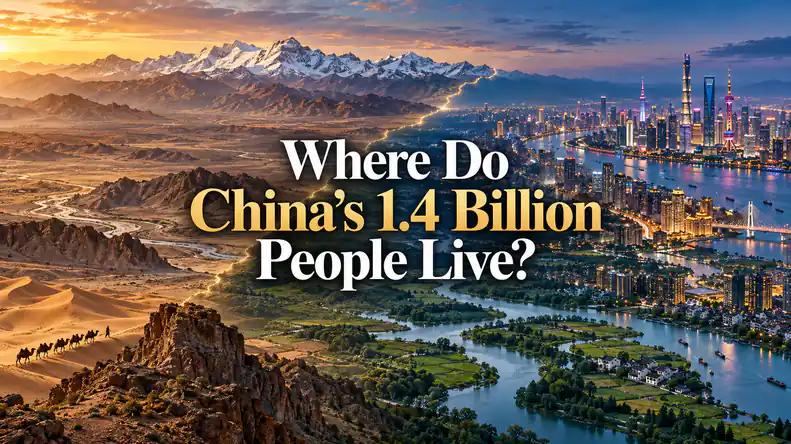
Hey there! I’m Hardy. If you look at a map of China and see that massive number—1.4 billion people—it can honestly be a bit mind-boggling.
When I first started traveling across the country, I had this funny idea that every corner of China would look like Times Square: packed tight with skyscrapers, neon lights, and shoulder-to-shoulder crowds. But then I took a 10-hour train ride from the neon-lit concrete jungle of Shanghai out toward the quiet, misty mountains of Guizhou. As I watched the landscape shift from endless high-rises to sleepy farming villages and dramatic green peaks, I realized something fascinating.
China’s population isn’t spread out evenly at all. In fact, the vast majority of the country lives on just one side of an imaginary line!
If you’re a curious traveler trying to wrap your head around how a billion and a half people share space, weather, and land, here is my guide to understanding China’s population distribution.
1. The Map That Changed My Mind
Let me take you back to that train ride. I was staring out the window, watching the blur of concrete buildings slowly give way to rolling hills, then to terraced rice paddies, and eventually to quiet rural homes where water buffalo grazed in the afternoon sun.
Before that trip, I assumed China was just uniformly crowded everywhere. But sitting on that train made me realize how dynamic the geography really is. In one day, I went from standing shoulder-to-shoulder with millions of commuters in a futuristic eastern hub to sitting by a quiet river where I could hear the wind rustling through the bamboo.
How can a country of 1.4 billion people have both ultra-dense megacities where you can’t see the horizon and jaw-droppingly empty mountain ranges where you might not see another soul for miles? The answer comes down to a mix of history, climate, and geography.
2. The Great Divide: The Hu Line Explained
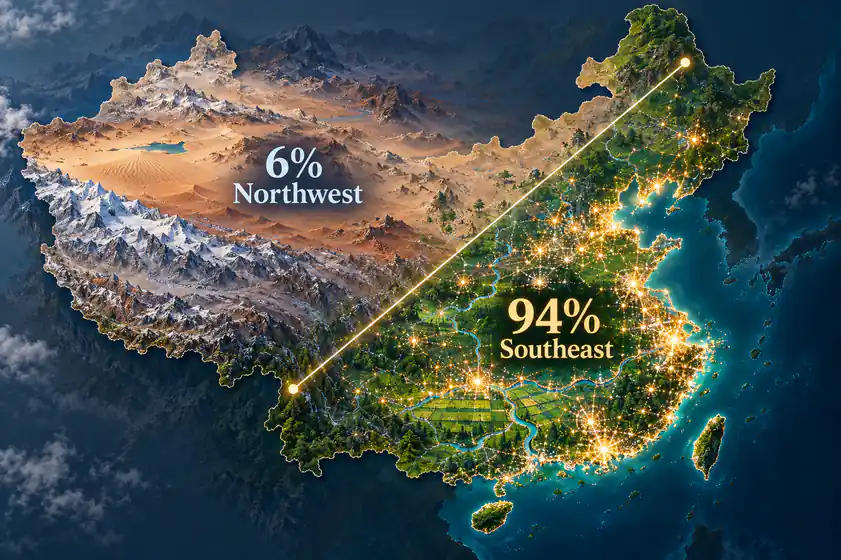
To truly understand where everyone lives, you have to know about a famous imaginary boundary called the Hu Line (also known as the Aihui-Tengchong Line).
Back in 1935, a Chinese geographer named Hu Huanyong drew a straight diagonal line across the map of China, stretching from the northeastern corner (Heihe) down to the southwestern corner (Tengchong). It cuts the country almost perfectly in half.
Here is the mind-blowing part: That line hasn’t changed in nearly a century.
- To the southeast of this line live roughly 94% of China’s population.
- To the northwest of this line live only about 6% of the population.
Think about that for a second. More than 1.3 billion people are squeezed into the southeastern half, while the northwestern half—which covers over half of China’s total land area—is vast, wild, and wide open. When you travel, you can literally feel this divide. Cross over to the east, and you are never far from a bustling town or a crowded highway. Venture deep into the northwest, and you enter a world of endless deserts and high-altitude solitude.
3. The Climate Connection: Why People Live Where They Do
So, why did everyone end up on the southeast side of the line? Is it just random luck? Not at all. It comes down to basic survival: climate and water.
If you look at the southeastern half of China, you’ll find great river systems like the Yangtze River and the Pearl River Delta. This region gets heavy seasonal monsoons, bringing warm, wet air that feeds lush agriculture. Historically, if you want to feed a massive population, you need fertile soil, dependable rain, and plenty of rice paddies or wheat fields. The climate here made it possible to grow enough food to support thriving villages, which eventually grew into towns, and then into megacities.
On the flip side, the northwest side of the Hu Line is dominated by extreme geography. You have the towering, freezing Tibetan Plateau, the massive Gobi Desert, and rugged mountain ranges. The climate there is harsh, dry, and unforgiving. While it is breathtakingly beautiful—trust me, watching the sunset over the grasslands of Inner Mongolia or the dunes of Xinjiang is a life-changing experience—it simply cannot support millions of farmers the way the southern river valleys can.
For travelers, this climate shift is wonderful because it means you get completely different worlds within one country. A tropical beach in Hainan feels like a different planet compared to a snowy yurt in northern Xinjiang.
For a closer look at how geography shapes everyday public life, step into Chengdu’s teahouses and discover Sichuan Mahjong as a Chengdu way of life.
4. The Megacity Clusters: Where the Crowds Are
If you want to experience the 94% side of the Hu Line, get ready for some serious energy. China’s population is heavily concentrated into a few massive “megacity clusters.”
Instead of having just one or two big cities like New York or London, China has entire networks of cities that have grown into each other.
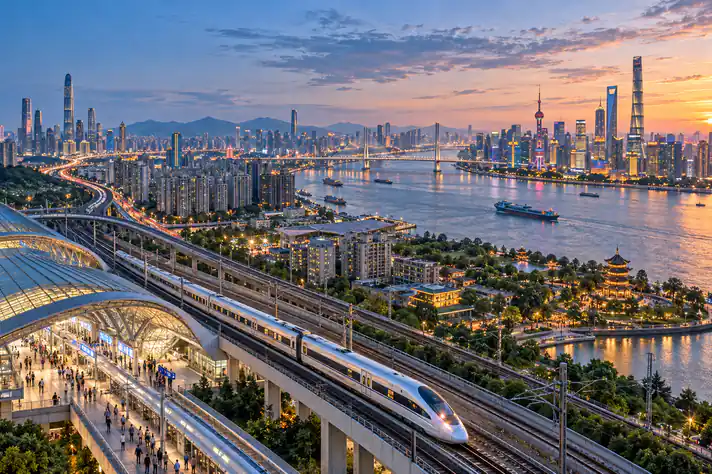
- The Yangtze River Delta: Anchored by Shanghai, this region includes cities like Suzhou, Hangzhou, and Nanjing, forming an economic powerhouse of over 150 million people connected by bullet trains.
- The Greater Bay Area: Down south, cities like Guangzhou, Shenzhen, and Hong Kong form a sprawling tech and cultural hub where millions of people move every year for work and innovation.
- The Beijing-Tianjin-Hebei Region: Up north, the political and cultural core brings millions more together around the capital.
When you walk through these urban clusters, the scale is staggering. Subway systems span hundreds of miles, skyscrapers pierce the clouds, and the pace of life is lightning-fast. It’s an intoxicating atmosphere for anyone who loves the buzz of modern civilization.
5. The Other Side: The Quiet, Vast Northwest
Now, let’s cross back over to the 6% side of the line. If you want to escape the crowds, this is where you go.
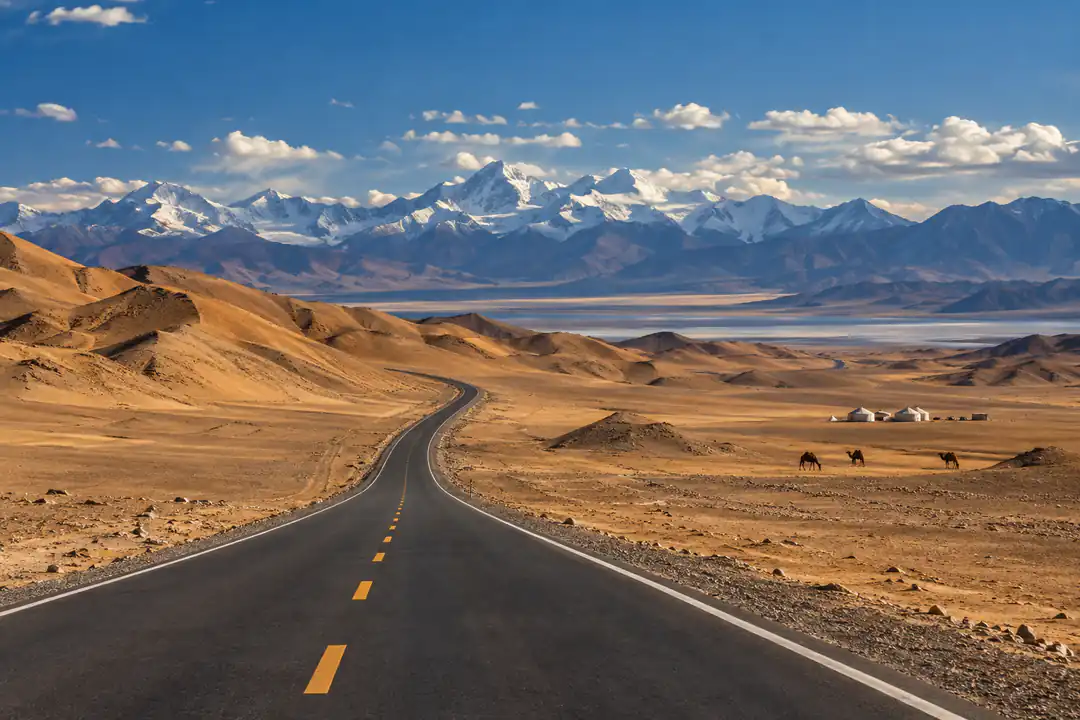
Provinces like Xinjiang, Qinghai, Gansu, and parts of Inner Mongolia offer a completely different side of China. Here, the landscape is defined by space. You can drive for hours along desert highways or mountain passes and see nothing but shifting sand dunes, jagged snow-capped peaks, and nomadic families tending to herds of sheep or camels.
The cultural fabric here is also shaped by geography. Because these regions historically served as crossroads for the ancient Silk Road, you’ll find incredible blends of Central Asian, Islamic, and traditional Chinese influences, from the food (think cumin-spiced lamb skewers and handmade noodles) to the music and architecture.
Traveling out here taught me to appreciate the silence. When you stand in the middle of a vast desert or look up at a star-filled sky over the high plateaus, the 1.4 billion people on the other side of the country feel a million miles away.
6. Hardy’s Tips for Travelers: Navigating the Contrasts
Because China’s population and climate are so unevenly distributed, planning a trip requires a little bit of strategy. Here are a few things I always keep in mind:
- Choose Your Vibe: Decide early on what kind of trip you want. If you want high-speed convenience, neon nightlife, and modern culture, stick to the eastern and southern megacities. If you want epic road trips, quiet landscapes, and deep historical cross-currents, head west.
- Pack for Extreme Shifts: Because the climate changes wildly based on population zones and geography, don’t assume the weather is the same everywhere. I once packed light for a sunny spring day in Chengdu, only to freeze when I took a mountain train up to a higher altitude where snow was still melting! Always check regional forecasts.
- Embrace the Scale: Keep the Hu Line in mind when you look at your travel itinerary. Trying to cross from an ultra-dense eastern hub to a remote western region in a single day can be exhausting. Give yourself time to adjust to the changing pace of life.
7. A Country of Many Worlds
At the end of the day, China isn’t just one monolithic place. It’s a vast collection of vastly different climates, provinces, and human stories molded by geography.
Understanding where the people live—and why they live there—gives you a much deeper appreciation for what you see out the window. Whether you’re weaving through a crowded night market in Shanghai or watching the stars over a silent desert in the northwest, you’re witnessing how millions of years of land and climate shaped the human story.
So, where will your travels take you? Into the buzzing, neon heart of the 94%, or out into the wide-open spaces of the 6%? Either way, an unforgettable adventure is waiting for you.