Sichuan Mahjong: A Chengdu Way of Life
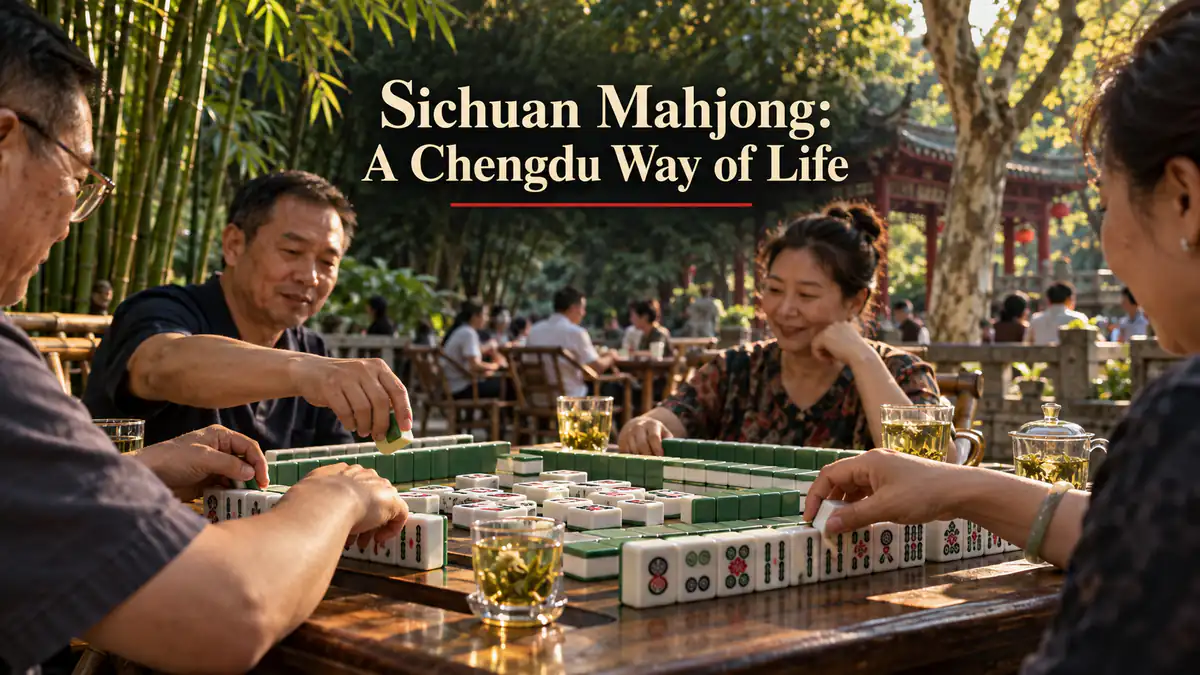
Hey there! I’m Hardy. If you’ve ever strolled through a park, wandered down a leafy alley, or sipped tea by a river in Chengdu, you’ve definitely heard the sound. It’s a rhythmic, hypnotic clatter—pieces of bamboo and heavy bone sliding across wooden tables, accompanied by bursts of laughter, groans of mock despair, and the quick-fire chatter of the local dialect.
That is the absolute soundtrack of Sichuan. It’s the sound of Sichuan Mahjong.
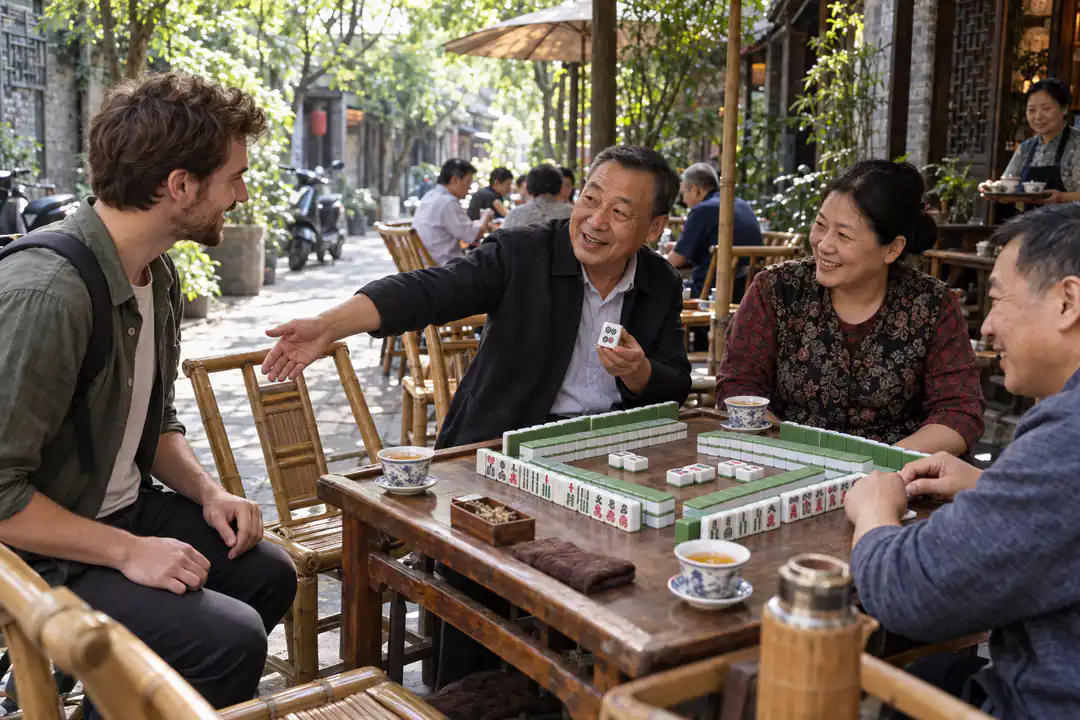
When I first sat down at a weathered bamboo table in People’s Park, I hadn’t the faintest idea what I was doing. I didn’t know a bamboo stick from a character tile, and my Mandarin was barely enough to order a plate of dumplings. I just saw the colorful tiles, heard the cheerful chaos, and figured I’d try my luck. An older uncle with a hand-fan just smiled, scooted his stool over, and gestured for me to take a seat.
Three hours later, I didn’t just learn a game. I learned how Chengdu slows down time, how neighbors become family, and why this simple board game is the heartbeat of southwest China.
Chengdu’s lively public spaces are also part of a much bigger geographic story. Understanding where China’s 1.4 billion people live helps put the city’s density and street culture in context.
If you’re planning a trip to Sichuan and want to understand why locals can play this game from morning till night, here is my traveler’s guide to the culture of Mahjong.
1. The Soundtrack of Chengdu
Let’s be honest: in most parts of the world, board games or card games happen behind closed doors. You sit in a living room, or maybe a quiet game café, keeping your cards close to your chest.
Not in Chengdu.
Here, mahjong is a spectator sport, a community gathering, and public art all rolled into one. Walk into any park, and you will see hundreds of tables set up under the shade of giant bamboo trees. Step into a neighborhood alleyway, and you’ll find tables squeezed between vegetable stalls and laundry lines. On a warm afternoon, you might even see people playing right on the sidewalk, completely unfazed by the scooters buzzing past or pedestrians walking by.
When I first experienced this openness, it blew my mind. There is zero pretense. It doesn’t matter if you are a wealthy tech worker, a retired street cleaner, or a curious traveler from halfway across the world—if there’s an open seat at the table, you are welcome to pull up a stool and watch the tiles fly.
It taught me my first big lesson about Sichuan culture: people here don’t hide their lives away. They share their joy, their competition, and their downtime right out in the open.
2. What Makes Sichuan Mahjong Different?
If you’ve ever played standard Chinese mahjong (or watched a movie version of it), forget everything you know. Sichuan mahjong is a whole different beast. It is faster, louder, more aggressive, and—let’s be honest—a lot more fun.
- No Suit Allowed: In traditional mahjong, you might collect suits of characters, bamboos, and dots. In the Sichuan version, you have to throw away one entire suit at the very beginning of the game. This forces everyone to attack furiously. There’s no playing it safe!
- The Game Doesn’t Stop: In most games, when one person wins, everyone packs up and starts over. In Sichuan? Oh no. When the first person wins, the game keeps going for the remaining players until all the prizes are claimed. That means the tension actually increases after the first victory.
- The Physical Energy: People don’t politely place tiles down. They slam them onto the wooden board with a satisfying thwack that echoes across the courtyard. It sounds intense, but it’s all part of the theatrical joy of the game.
Because the rules are streamlined to be fast-paced, it creates an atmosphere of high energy. Even if you don’t understand the scoring, watching players calculate their moves with lightning speed is mesmerizing.
3. Mahjong as the Ultimate Social Glue
Why do people love it so much? Is it about the money? (Sure, small stakes are common—often just covering the cost of the tea or a bowl of noodles). But money isn’t the real point.
Mahjong in Sichuan is the ultimate social glue. It’s how a community stays connected.
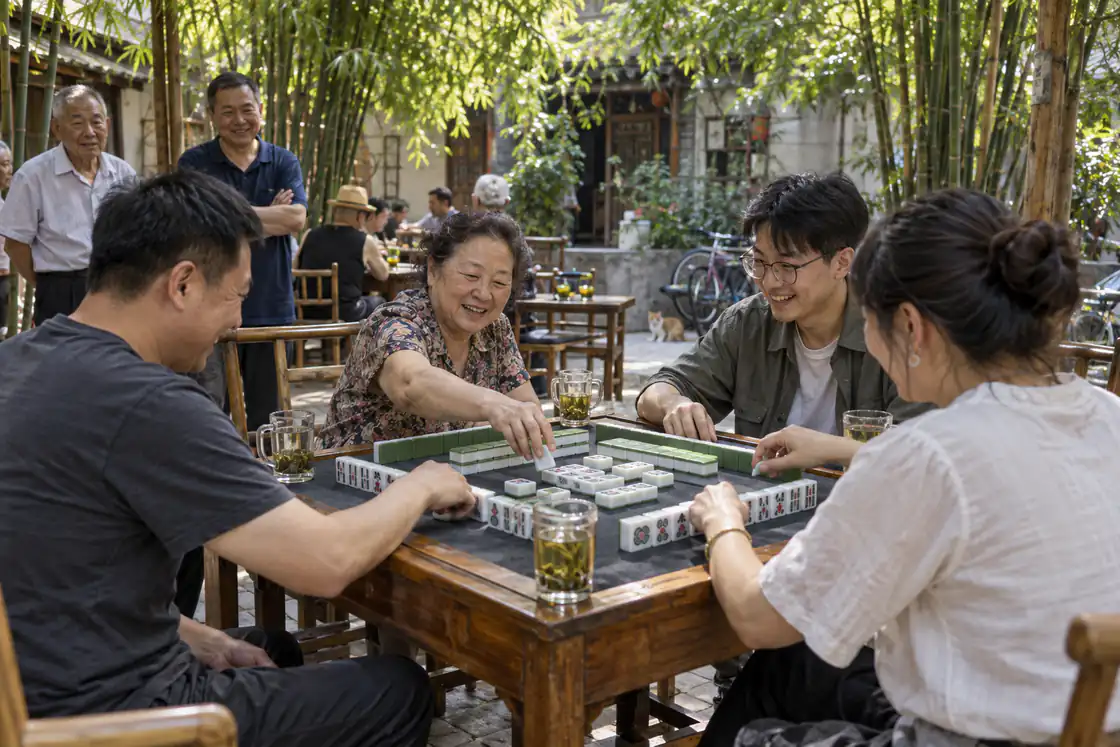
In a modern world where people are glued to their smartphones, the mahjong table forces human contact. It requires you to look your neighbor in the eye, laugh at their bad luck, and banter back and forth. I watched three generations of a family gather around a table on a Sunday afternoon, with the grandfather teaching his teenage granddaughter how to bluff. No one was looking at a screen. Everyone was fully present.
And we have to talk about the legendary “Aunties” (Ayi) of Chengdu. If you think old ladies are quiet and reserved, you haven’t met a Sichuan ayi at a mahjong table. They play with laser-focused intensity, sharp wit, and zero hesitation. They will call out your mistakes with a grin and dominate the board while sipping jasmine tea from a glass mug. They are the true queens of the Chengdu streetscape.
At the table, social status dissolves. A local government official and a fruit vendor can sit shoulder-to-shoulder, arguing playfully over a tile. For a few hours every day, everyone is just an equal player in the great theater of the game.
4. Hardy’s Favorite Spots to Experience the Magic
If you want to witness or join in on the mahjong tradition during your trip to Chengdu, you don’t need to search hard. But a few places hold a special place in my heart:
- People’s Park (Renmin Park): This is the holy grail. Head there on a sunny afternoon, grab a cup of local green tea at the famous Heming Teahouse, and just wander among the bamboo groves. You will find endless rows of tables. It’s loud, it’s vibrant, and it’s pure Chengdu.
- The Old Alleyways (Tongzilin & Shuinianwan): Step away from the main tourist attractions and walk into residential neighborhoods. Look for small, open-air courtyards or shady spots under massive banyan trees. This is where you’ll see locals playing purely for the love of the game, far away from the camera lenses.
- Ancient Towns on the Outskirts: Places like Huanglongxi or Luodai offer a glimpse of traditional Sichuan life. Playing mahjong next to old stone bridges and flowing canals feels like stepping back a hundred years in time.
5. Hardy’s Guide to Joining a Game Without Looking Silly
Want to try your hand at the table? Go for it! But keep a few friendly pointers in mind so you blend in and have a great time:
- Brush Up on the Basics: You don’t need to be a master, but download a digital version of Sichuan mahjong before your trip to learn the basic tile matching. It will save you from complete confusion.
- Start as a Spectator: Walk up slowly, keep a respectful distance (don’t hover right over someone’s shoulder—that’s bad luck!), and smile. If the players look relaxed, you can quietly watch a hand play out.
- Embrace the Body Language: If you don’t speak Chinese, don’t worry. A shrug, a thumbs-up, or a laugh when someone draws a lucky tile translates universally. Laughter is the primary language at these tables.
- Find a Patient Table: Look for a table with older folks who are smiling and chatting rather than intensely hyper-focused. They are usually more than happy to let a curious foreign traveler fumble through a round.
6. Conclusion: A Tile of True Happiness
At the end of the day, Sichuan Mahjong is much more than a pastime. It is a philosophy wrapped in bamboo and bone.
It teaches us to slow down, to gather with friends, and to find joy in the simple, repetitive rhythms of daily life. In a fast-moving world, Chengdu holds onto its tranquility by sitting down, pouring a fresh cup of tea, and shuffling the tiles for another round.
When you visit Sichuan, don’t just rush from temple to temple or spend all your time looking for pandas. Take an afternoon off. Find a quiet teahouse under the shade of a bamboo tree, listen to the comforting, rhythmic clatter of the tiles, and let the city work its magic on you. Pull up a stool. Take a deep breath. You’re right where you belong.