China’s 240-Hour Visa-Free Transit Policy: A Practical 2026 Guide

Last checked: October 23, 2026
Hey there! I’m Hardy. A few days in China can take you surprisingly far: from Beijing’s hutongs to Shanghai’s riverside skyline, or from a busy Chengdu noodle shop to a quiet afternoon in a teahouse.
For some travelers, those days can fit into a journey without applying for a Chinese visa in advance. China’s 240-hour visa-free transit policy allows eligible visitors to spend up to 10 days in permitted areas while continuing to another country or region.
The part to check carefully is your route. Having an eligible passport is only the beginning. Where you arrive from, where you go next, and which border crossing you use all matter.
Before you start booking hotels, here is how to work through the rules.
1. The Quick Version: Who Can Visit China for 240 Hours?
As of the date above, the policy covers ordinary passport holders from 57 countries, entering through 65 designated ports and traveling within permitted areas across 24 provincial-level regions.
| What to check | The basic requirement |
|---|---|
| Your passport | An ordinary passport from an eligible country |
| Passport validity | At least three months remaining |
| Your route | Travel through mainland China to a different country or region |
| Your onward ticket | Confirmed travel with a departure date and seat |
| Your entry point | One of the 65 designated entry ports |
| Your travel plans | Stay within the permitted geographical areas |
| Your departure | Leave before the deadline granted by immigration |
The latest nationality and port totals come from the National Immigration Administration’s current policy notice. The application requirements also include an on-site immigration review; meeting the conditions does not guarantee permission to enter.
One useful check comes even before this table: does your passport qualify for a separate visa-free entry policy? China has other visa exemptions with different conditions. If one applies to your trip, you may not need to rely on the transit policy at all.
2. What “Visa-Free Transit” Actually Means
The policy lets you enter mainland China temporarily while traveling onward to a third country or region.
Think of it like this:
Country or Region A → Mainland China → Country or Region C
A and C must be different.
For example, a journey from the United States to Shanghai and then Japan has the right basic route structure. A journey from the United States to Shanghai and straight back to the United States does not.
Your nationality determines whether your passport is eligible. Your itinerary determines whether the journey counts as transit. Those are separate checks.
You may see people call this a “240-hour transit visa.” The official term is visa-free transit. You do not obtain a tourist visa under this scheme; you apply for temporary entry permission at the border.
That distinction matters when speaking to an airline or immigration officer. Explain that you intend to use the 240-hour visa-free transit policy, and have the complete itinerary ready.
3. Check Your Eligibility Before Booking

Start with the passport you will actually use
Your ordinary passport must be issued by one of the 57 eligible countries. Residence in an eligible country does not, by itself, qualify a traveler whose passport is from elsewhere.
The complete nationality list is in the reference section at the end of this article.
Check passport validity and your next destination’s requirements
Official application guidance requires a travel document with at least three months of validity. You must also meet the entry requirements of your onward destination.
If that destination requires a visa, electronic authorization, or another document, prepare it before departure.
Book the journey out of mainland China
You need confirmed onward travel to a third country or region, with a definite departure date and seat within the permitted period.
An intention to book later is not enough. Keep the booking confirmation accessible offline, including your name, travel date, route, and reservation details.
Official wording refers to onward or connecting tickets and supporting evidence. If you are using separate bookings, different carriers, or a combination of transport types, confirm the documents with your carrier and China’s 12367 immigration service before committing to the journey.
Check the border crossing, not just the city
An eligible destination does not make every nearby airport, railway crossing, or ferry terminal eligible for entry.
Look up the exact port name on the official list. This is especially useful around Hong Kong, Macao, and Guangdong, where several crossings serve the same wider region.
Allow for the immigration review
Travel history and other circumstances can affect an application. Official guidance identifies grounds for refusal, including insufficient passport validity, certain refusal stamps, and specified immigration violations in China during the preceding five years.
If your circumstances are unusual, get advice before departure rather than assuming a flight booking resolves the issue. See the official application guidance published by Beijing authorities for the document requirements and on-site review process.
4. Does Your Route Qualify? Examples Make It Easier
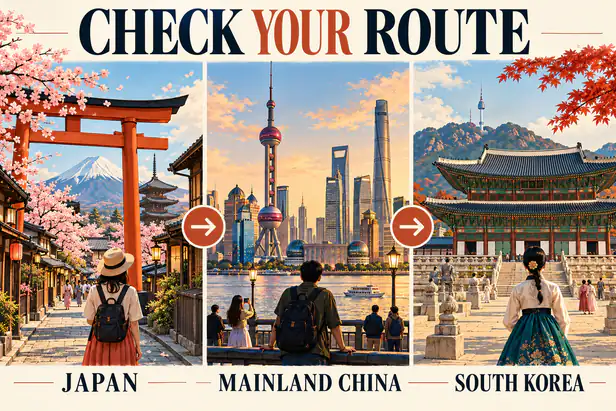
The following are hypothetical examples of the route rule. They assume the traveler also meets the passport, ticket, port, and other entry conditions.
| Example itinerary | Route assessment |
|---|---|
| San Francisco → Shanghai → Tokyo | Meets the basic third-country route requirement |
| Tokyo → Beijing → Seoul | Meets the basic third-country route requirement |
| Toronto → Guangzhou → Hong Kong | Can meet the route requirement; check the specific onward crossing and ticket |
| London → Beijing → London | Does not meet the route requirement |
| Paris → Shanghai → Lyon | Does not meet the route requirement: both ends are in France |
| Seoul → Shanghai → Seoul → Tokyo | Does not meet the route requirement for the China segment: the immediate onward destination is South Korea |
That last example is easy to overlook. Adding another destination later does not necessarily change the country or region immediately before and after mainland China.
A practical way to check is to write down those two places first. If they are the same country or region, pause before relying on transit exemption.
What about Hong Kong, Macao, and Taiwan?
These can serve as onward destinations for the transit route requirement, provided they differ from the place you arrived from and the rest of your journey qualifies.
For example, flying from Japan to Shanghai and continuing to Hong Kong has a different route structure from flying from Hong Kong to Shanghai and returning directly to Hong Kong.
MTR’s guidance for foreign passengers using high-speed rail explains how the policy can apply to journeys involving Hong Kong. Check your exact crossing and ticket combination before travel.
5. When Does the 240-Hour Clock Start?

The permitted period is calculated from 00:00 on the day after entry, according to official guidance.
Here is a hypothetical example, using local time in China:
| Event | Date and time |
|---|---|
| You enter China | November 1, 2026, at 3:00 p.m. |
| The 240-hour period begins | November 2 at 00:00 |
| Ten days have elapsed | November 12 at 00:00 |
In this example, you would need to leave before the period expires, during November 11 at the latest.
The most useful habit is to check the departure deadline recorded by immigration before leaving the counter. If anything is unclear, ask there.
The Shanghai border inspection explanation confirms the next-day-midnight calculation.
For planning, leave some breathing room. A departure comfortably before the deadline gives you more options if transport is disrupted.
6. Where Can You Enter, Travel, and Leave?
There are three separate questions here: your entry port, the places you visit, and your exit port.
Enter through a designated port
The 65 entry ports include major airports such as Beijing Capital, Beijing Daxing, Shanghai Pudong, Guangzhou Baiyun, Shenzhen Bao’an, and Chengdu Tianfu.
They also include selected seaports and railway crossings.
Five Guangdong-related entry ports were added on November 5, 2025: Guangzhou Pazhou Ferry Terminal, Hengqin Port, Hong Kong–Zhuhai–Macao Bridge Port, Zhongshan Port for passengers, and the West Kowloon Station port of the Guangzhou–Shenzhen–Hong Kong Express Rail Link. This brought the total from 60 to 65. See the National Immigration Administration announcement.
Travel within the permitted areas
You can travel between permitted areas across the 24 provincial-level regions. You are not automatically restricted to the city where you arrived.
However, 24 regions does not mean unrestricted travel throughout all 24.
Most are covered in full, but six have limits to specified cities or prefectures: Shanxi, Heilongjiang, Jiangxi, Guangxi, Sichuan, and Yunnan.
This makes a real difference when planning. A Chengdu visit and a Leshan excursion fall within the listed Sichuan area. You should not assume every destination elsewhere in Sichuan is covered.
The detailed area list is below. Check every stop, including overnight stays and side trips.
You can use a different exit port
You do not generally have to leave through the port where you entered.
Arriving in Shanghai and departing from Beijing can work if your full itinerary meets the conditions and stays within the permitted areas.
Guangdong has an additional rule allowing departure through the province’s other open exit ports. The Shenzhen Port Office’s explanation describes that distinction. Confirm the specific crossing, passenger service, and onward evidence if you plan to use it.
7. What Happens When You Arrive?

The process is easier to follow when your documents tell one clear story.
Before departure
Have these ready:
- Your passport.
- Your confirmed onward ticket.
- Any entry documents required by your next destination.
- Your first accommodation’s name and address.
- A simple outline of where you intend to travel.
Save copies offline. Being able to open a booking without airport Wi-Fi is useful.
At check-in, tell the carrier that you intend to use the 240-hour visa-free transit policy. For a complex itinerary, contact the carrier before travel day.
At the Chinese border
Follow signs for visa-free transit or temporary entry applications, or ask a member of staff where to go.
You will need to provide the required arrival information, present your documents, and answer questions about your journey. Be ready to explain where you came from, where you are staying, and how you will leave.
Once permission is granted, check the recorded departure deadline.
After reaching your accommodation
Accommodation registration still applies.
Hotels handle registration through their check-in procedures. If you stay in a private home or another non-hotel residence, you or your host must arrange registration with the local public security authorities within 24 hours.
The Chinese Consulate-General in Montreal’s official guidance explains registration and the obligations during a transit stay.
8. What Can You Do During Your Stay?
The policy permits activities such as tourism, business visits, visiting friends, and family reunions.
That leaves plenty of room for an enjoyable stopover: museums, markets, neighborhood walks, meals with friends, or a few days exploring another permitted city.
Work, study, and news reporting are among the activities that still require prior approval and appropriate visas. A short stay does not automatically remove those requirements.
For ordinary sightseeing, the more practical limitation is geographical. Check that the places you want to visit are inside the permitted areas before booking transport.
9. The Mistakes Most Worth Avoiding
A few small assumptions can create large problems at check-in or immigration.
Treating a return trip as transit.
Changing the city you fly home to does not change the country. Paris → Shanghai → Lyon still begins and ends in France.
Planning to buy the onward ticket after arrival.
Your departure needs to be documented before you apply for temporary entry.
Checking the province but missing its city restrictions.
“Sichuan is included” does not mean the entire province is open under this policy.
Choosing a crossing because it looks convenient on the map.
Entry eligibility depends on the named port, not simply its location.
Using an old 144-hour guide.
Older articles can contain superseded nationality totals, ports, or geographical rules. Check the publication date and the current official notice.
Confusing transit exemption with another visa-free policy.
Your passport may qualify for a different option. Check that first, then plan around the conditions of the policy you will actually use.
10. How Does It Compare with Other Visa-Free Options?
On smaller screens, swipe the table sideways to compare all three options.
| Question | 24-hour visa-free transit | 240-hour visa-free transit | Other visa-free entry policies |
|---|---|---|---|
| Who is covered? | Nationals of all countries under the general policy, subject to applicable conditions | Ordinary passport holders from 57 listed countries | Depends on the agreement or policy |
| How long? | Up to 24 hours | Up to 240 hours | Depends on the applicable policy |
| Must the journey continue to a third country or region? | Yes | Yes | Not necessarily |
| Can you leave the restricted port area? | Only with temporary entry permission | Yes, after entry approval, within permitted areas | According to the applicable conditions |
| Where can you travel? | Subject to the permission granted | Designated areas across 24 provincial-level regions | Depends on the applicable policy |
The National Immigration Administration’s policy page explains both transit schemes.
For a straightforward return holiday, check the ordinary visa-free options available to your passport or apply for an appropriate visa. Do not build a transit itinerary until you know you need one.
11. Three Ways to Spend Your Transit Stay
Once the entry details are settled, give yourself permission to enjoy the trip.
These are suggested travel ideas, not pre-approved immigration itineraries. Your international route and border crossings still need to qualify.
Beijing, Tianjin, and Hebei

Make Beijing your main base, with time for its historic neighborhoods and major sights. Add Tianjin or a suitable Hebei excursion if you want a change of pace.
You do not need to move hotels every night to make ten days feel worthwhile. Leaving room for an unplanned walk or a long lunch often makes the trip more enjoyable.
Shanghai, Suzhou, and Hangzhou

This combination offers a manageable contrast between a large international city, gardens and canals, and lakeside scenery.
It also gives you a closer look at the densely populated eastern part of the country. Our article on where China’s 1.4 billion people live explains the geography behind those busy city networks.
Chengdu and Leshan

For a slower trip, spend several days in Chengdu and add Leshan rather than racing across the country.
Leave an afternoon for tea and people-watching. Our guide to Sichuan mahjong and Chengdu’s teahouse culture offers a way into the city’s everyday social life.
After a long sightseeing day, you might also enjoy learning about China’s foot bath culture.
If you extend the itinerary beyond these cities, check the Sichuan permitted-area list carefully. The province is only partially covered.
12. A Few More Questions Travelers Ask
Can I arrive by plane and leave by train or ship?
A mixed-transport itinerary can be possible through applicable ports. The exact crossing, confirmed passenger service, and onward ticket evidence matter. Check the complete journey with the carriers and 12367 before booking.
Do separate airline tickets qualify?
Do not assume that either one booking reference or two automatically determines eligibility. Official guidance requires confirmed onward travel and supporting evidence. Have both bookings available and verify your particular combination with the operating carrier and immigration service.
Do children qualify?
Check each child’s nationality, passport, documents, and onward travel individually. Do not assume a parent’s eligibility automatically covers every family member.
What if my flight is cancelled?
A cancellation does not automatically extend your permission to stay. If a disruption may cause an overstay, contact the local public security exit-entry administration before your deadline. Keep the carrier’s cancellation notice and seek instructions promptly.
Can I extend the stay because I want more time?
Do not plan on it. Official guidance provides for applications for stay documents in circumstances such as sudden illness or force majeure. Wanting a longer holiday should be handled by choosing an appropriate entry option before departure.
Can I visit places outside the permitted regions?
Not while relying on this transit permission. That includes destinations outside the 24 listed regions and places excluded from the partially covered provinces.
Is the policy limited to air passengers?
No. The designated entry list also includes selected seaports and railway ports. Availability depends on the specific port and service; it does not make every land, rail, or sea crossing eligible.
Who should I contact about an unusual itinerary?
Contact your operating carrier and China’s 12367 immigration service. The official guidance lists +86 12367 for calls from overseas.
Have your nationality, exact ports, dates, transport details, and the countries or regions immediately before and after mainland China ready.
13. Before You Head to the Airport
Run through the details once more:
- My passport is eligible and has sufficient validity.
- I have checked whether a different visa-free policy suits my trip.
- The places immediately before and after mainland China are different countries or regions.
- My onward travel is confirmed.
- My entry port is on the designated list.
- Every planned destination is inside the permitted areas.
- I have accommodation details and offline booking copies.
- I have allowed time before the immigration departure deadline.
Then keep the trip itself manageable. A stopover gives you enough time to get beyond the airport and begin to understand a place. You can have a satisfying visit without trying to fit half the country into it.
Reference Lists: Countries, Travel Areas, and Entry Ports
Expand the lists below to check your passport, destinations, and entry point. These reflect the National Immigration Administration notice updated August 20, 2026.
The 57 eligible countries
Europe — 40
Albania, Austria, Belarus, Belgium, Bosnia and Herzegovina, Bulgaria, Croatia, Cyprus, Czech Republic, Denmark, Estonia, Finland, France, Germany, Greece, Hungary, Iceland, Ireland, Italy, Latvia, Lithuania, Luxembourg, Malta, Monaco, Montenegro, the Netherlands, North Macedonia, Norway, Poland, Portugal, Romania, Russia, Serbia, Slovakia, Slovenia, Spain, Sweden, Switzerland, Ukraine, and the United Kingdom.
Americas — 6
Argentina, Brazil, Canada, Chile, Mexico, and the United States.
Oceania — 2
Australia and New Zealand.
Asia — 9
Brunei, Indonesia, Japan, Kyrgyzstan, Qatar, Singapore, South Korea, the United Arab Emirates, and Vietnam.
Permitted travel areas in the 24 regions
Regions covered in full
Beijing, Tianjin, Hebei, Liaoning, Shanghai, Jiangsu, Zhejiang, Anhui, Fujian, Shandong, Henan, Hubei, Hunan, Guangdong, Hainan, Chongqing, Guizhou, and Shaanxi.
Regions with geographical limits
| Region | Permitted cities or prefectures |
|---|---|
| Shanxi | Taiyuan and Datong |
| Heilongjiang | Harbin |
| Jiangxi | Nanchang and Jingdezhen |
| Guangxi | Nanning, Liuzhou, Guilin, Wuzhou, Beihai, Fangchenggang, Qinzhou, Guigang, Yulin, Hezhou, Hechi, and Laibin |
| Sichuan | Chengdu, Zigong, Luzhou, Deyang, Suining, Neijiang, Leshan, Yibin, Ya’an, Meishan, and Ziyang |
| Yunnan | Kunming, Yuxi, Chuxiong, Honghe, Wenshan, Pu’er, Xishuangbanna, Dali, and Lijiang |
Use the current NIA port and permitted-area table as the final reference when checking your destinations.
The 65 designated entry ports
“Port” means a border entry point. It can be an airport, passenger seaport, or railway crossing.
| Region | Designated entry ports |
|---|---|
| Beijing | Beijing Capital International Airport; Beijing Daxing International Airport |
| Tianjin | Tianjin Binhai International Airport; Tianjin Seaport, passenger services |
| Hebei | Shijiazhuang Zhengding International Airport; Qinhuangdao Seaport, passenger services |
| Shanxi | Taiyuan Wusu International Airport |
| Liaoning | Shenyang Taoxian International Airport; Dalian Zhoushuizi International Airport; Dalian Seaport, passenger services |
| Heilongjiang | Harbin Taiping International Airport |
| Shanghai | Shanghai Hongqiao International Airport; Shanghai Pudong International Airport; Shanghai Seaport, passenger services |
| Jiangsu | Nanjing Lukou International Airport; Sunan Shuofang International Airport; Yangzhou Taizhou International Airport; Lianyungang Seaport, passenger services |
| Zhejiang | Hangzhou Xiaoshan International Airport; Ningbo Lishe International Airport; Wenzhou Longwan International Airport; Yiwu Airport; Wenzhou Port, passenger services; Zhoushan Port, passenger services |
| Anhui | Hefei Xinqiao International Airport; Huangshan Tunxi International Airport |
| Fujian | Fuzhou Changle International Airport; Xiamen Gaoqi International Airport; Quanzhou Jinjiang International Airport; Wuyishan Airport; Xiamen Seaport, passenger services |
| Jiangxi | Nanchang Changbei International Airport |
| Shandong | Jinan Yaoqiang International Airport; Qingdao Jiaodong International Airport; Yantai Penglai International Airport; Weihai Dashuibo International Airport; Qingdao Seaport, passenger services |
| Henan | Zhengzhou Xinzheng International Airport |
| Hubei | Wuhan Tianhe International Airport |
| Hunan | Changsha Huanghua International Airport; Zhangjiajie Hehua International Airport |
| Guangdong | Guangzhou Baiyun International Airport; Shenzhen Bao’an International Airport; Jieyang Chaoshan International Airport; Nansha Port, passenger services; Shekou Port, passenger services; Guangzhou Pazhou Ferry Terminal; Hengqin Port; Hong Kong–Zhuhai–Macao Bridge Port; Zhongshan Port, passenger services; West Kowloon Station port of the Guangzhou–Shenzhen–Hong Kong Express Rail Link |
| Guangxi | Nanning Wuxu International Airport; Guilin Liangjiang International Airport; Beihai Fucheng Airport; Beihai Seaport, passenger services |
| Hainan | Haikou Meilan International Airport; Sanya Phoenix International Airport |
| Chongqing | Chongqing Jiangbei International Airport |
| Sichuan | Chengdu Shuangliu International Airport; Chengdu Tianfu International Airport |
| Guizhou | Guiyang Longdongbao International Airport |
| Yunnan | Kunming Changshui International Airport; Lijiang Sanyi International Airport; Mohan Railway Port |
| Shaanxi | Xi’an Xianyang International Airport |
This is the designated entry list. Guangdong’s additional exit arrangements should be checked separately. A port’s inclusion does not guarantee that a particular passenger service operates on your travel date.
Official Sources and Updates
This article draws on official immigration notices and government guidance:
- National Immigration Administration: Current Visa-Free Transit Policies
- National Immigration Administration: November 2025 Port Expansion
- Beijing Authorities: Application Requirements and Documents
- Shanghai Border Inspection: Calculating the Stay Period
- Chinese Consulate-General in Montreal: Transit Questions and Stay Obligations
Some older official pages still show earlier nationality or port totals. For those figures, use the current NIA notice.
Before paying for an unusual itinerary, check the latest rules and confirm the specific route with your carrier and 12367. The final decision on temporary entry is made by the border inspection authorities.
Images in this article are AI-generated editorial illustrations, not photographs or official immigration documents.