How to Eat Hot Pot Like a Local: Step-by-Step Guide for Beginners
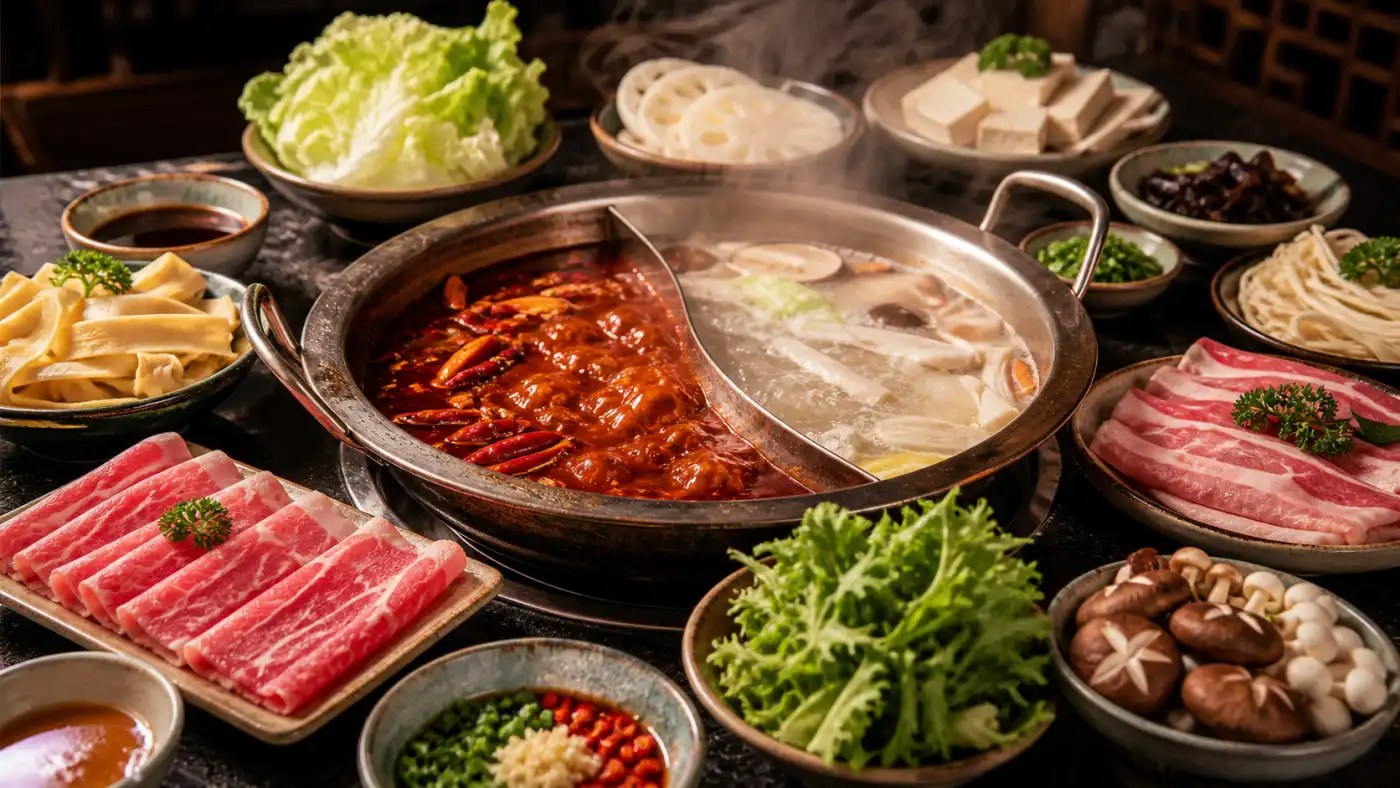
If you are wondering how to eat hot pot, the basic idea is simple:
You sit around a bubbling pot of broth, order raw ingredients, cook them at the table, dip them in sauce, and eat slowly with friends.
That is the polite explanation.
The more honest explanation is this: hot pot is a delicious social event where everyone pretends they know exactly which piece of beef is theirs, someone loses tofu in the soup forever, and the quietest person at the table suddenly becomes very serious about sauce.
Welcome to hot pot.
For first-time visitors to China, hot pot can feel confusing at first. There are different soup bases, different sauces, different cooking times, different regional styles, and some ingredients that may look like they came from a biology exam. But once you understand the rhythm, hot pot is one of the easiest and most fun meals you can have in China.
This guide is not only about how to cook hot pot at home. It is mainly for people who want to walk into a hot pot restaurant in China and know what is happening. We will cover what hot pot is, how hot pot works, what to put in hot pot, how to make dipping sauce, what to avoid, how much it costs, and how to eat it without looking completely lost.
Do not worry. Everyone is lost the first time.
The soup will guide you.
What Is Hot Pot?
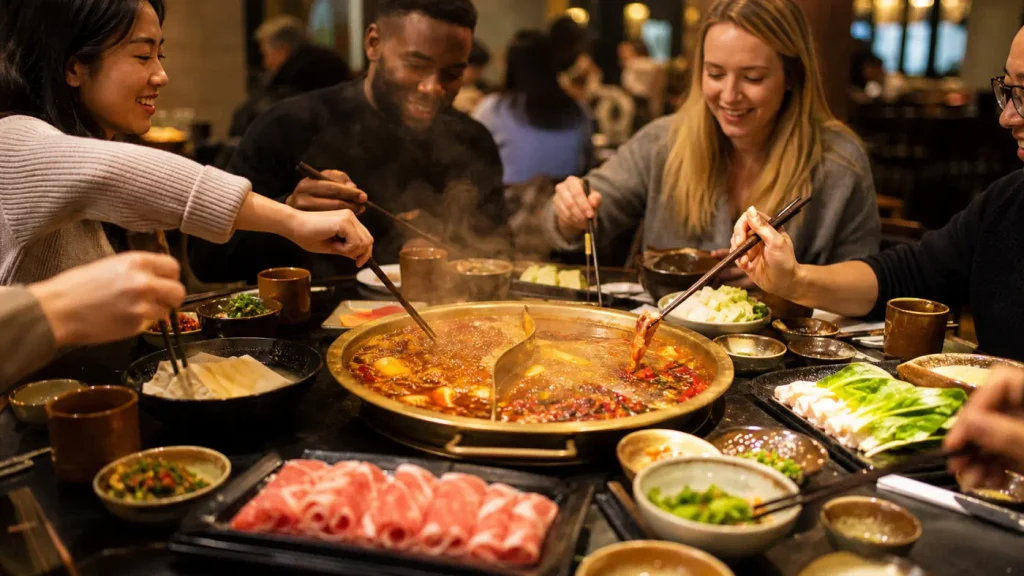
Hot pot is a shared meal built around a pot of simmering broth placed in the middle of the table. You order raw ingredients such as thinly sliced meat, vegetables, tofu, mushrooms, seafood, noodles, and sometimes animal organs. Then you cook the food yourself in the broth, take it out when it is ready, dip it in sauce, and eat.
That is the basic answer to “what is a hot pot?”
But hot pot is not just a cooking method. In China, it is also a social mood.
People eat hot pot when they want a long dinner, a group meal, a birthday, a reunion, a cold-weather comfort meal, or a spicy therapy session after a stressful week. It is especially popular in Sichuan and Chongqing, but different versions exist all over China.
Is hot pot Chinese or Korean?
This is a common question because many travelers also see Korean hot pot, Japanese shabu-shabu, Thai suki, and other Asian shared-pot meals.
The broad idea of cooking food in a shared pot exists in many Asian food cultures. But Chinese hot pot has its own long history, regional styles, ingredients, sauces, and dining rules. When people say “Chinese hot pot,” they usually mean one of many Chinese styles, such as Sichuan hot pot, Chongqing hot pot, Beijing copper-pot lamb, Chaoshan beef hot pot, or Yunnan mushroom hot pot.
Korean hot pot is not the same thing. It may share the communal cooking idea, but the broths, ingredients, sauces, and restaurant experience are different.
So if someone asks, “Is hot pot Korean?” the clean answer is:
Hot pot-style cooking exists in Korea too, but the hot pot most travelers talk about in China is Chinese hot pot.
Where did hot pot originate?
Hot pot does not have one perfectly neat origin story. Different regions have their own versions of boiling food in a shared vessel. But if we talk about the fiery, numbing, red-oil hot pot that many foreigners imagine today, Chongqing is the place to understand.
Chongqing sits where the Yangtze and Jialing rivers meet. It was historically a major river port, full of boatmen, dock workers, porters, and laborers. The story often told about Chongqing hot pot is that working people needed cheap, filling, warming food. Expensive cuts of meat were not realistic, so they cooked inexpensive beef offal and other scraps in a strong, spicy broth.
The spice had a purpose. Chili, Sichuan peppercorns, beef tallow, garlic, fermented bean paste, and other seasonings helped create a broth that was bold, warming, and powerful enough to handle strong-tasting ingredients like tripe and organs.
Over time, what began as rough riverside food became restaurant food. Then it became a city identity. Then it became a national obsession.
This is why Chongqing hot pot feels different from a gentle soup dinner. It was not invented to be cute. It was built by a river city with stairs, fog, sweat, and serious appetite.
Respect the pot.
How Does Hot Pot Work?
Hot pot works in four simple stages:
- Choose your broth.
- Order ingredients.
- Cook food in the pot.
- Dip the cooked food in sauce and eat.
The first time, this can feel like too many choices. But hot pot is forgiving. If you do not know what to order, you can always ask the server for recommendations.
In Chinese, you can say:
老板,推荐一下。
Lǎobǎn, tuījiàn yíxià.
Please recommend something.
This sentence has saved many dinners.
Common types of Chinese hot pot
Before you order, it helps to understand that “hot pot” is not one single flavor. China has many hot pot styles. Here are the big ones travelers are most likely to meet.
Sichuan hot pot
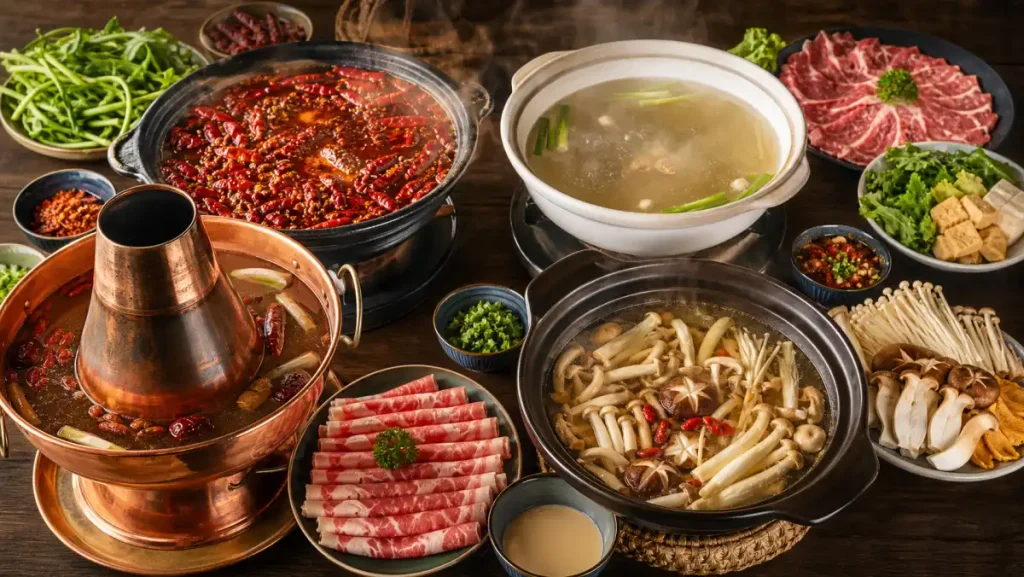
Sichuan hot pot is spicy, numbing, aromatic, and often deeply red. It uses chili, Sichuan peppercorns, spices, and oil. Chengdu-style hot pot can be spicy, but it is often a little more rounded and fragrant compared with Chongqing’s heavier, stronger style.
Also, yes, Chengdu has a famously open-minded, expressive city vibe. I even wrote a separate guide asking is Chengdu a gay city?. But if someone tells you gay people in Chengdu do not like hot pot, please ask for evidence. That sounds less like culture and more like a person who has not been invited to the right dinner.
Good for:
- People who want the classic spicy hot pot experience
- Beef, tripe, duck blood, mushrooms, tofu, and vegetables
- Travelers who can handle heat
Beginner warning: “mild spicy” in Sichuan may still be spicy if you are not used to Chinese spice levels. Sichuan people have a different legal system for chili.
Chongqing hot pot
Chongqing hot pot is bold, heavy, oily, numbing, and extremely confident. Traditional Chongqing hot pot often uses beef tallow and a strong mala broth. It is famous for ingredients like beef tripe, duck intestine, yellow throat, blood curd, and other items that make nervous beginners stare quietly at the menu.
Good for:
- Spicy food lovers
- Adventurous eaters
- People who want the most intense local hot pot experience
Beginner warning: do not drink the red broth. I am saying this gently because the broth is not soup in the Western sense. It is a spicy cooking medium. Your stomach does not need that speech.
Chaoshan beef hot pot
Chaoshan beef hot pot comes from the Chaoshan region in Guangdong. It is famous for fresh beef, clear broth, precise cuts, and short cooking times. The flavor is cleaner and lighter than Sichuan or Chongqing hot pot.
Good for:
- Beef lovers
- People who do not want spicy food
- First-time hot pot eaters who want something gentle
The sauce often includes satay-style sauce, garlic, celery, or chili depending on the restaurant.
Beijing copper-pot lamb hot pot
Beijing-style copper-pot lamb hot pot usually uses a tall copper pot with charcoal heat in the center. The broth is often very simple, because the main star is thinly sliced lamb. You cook the lamb quickly, then dip it into sesame paste sauce.
Good for:
- Lamb lovers
- Cold weather
- People who like sesame sauce
This style feels very northern: direct, warm, satisfying, and not trying to impress you with fireworks.
Yunnan mushroom hot pot
Yunnan mushroom hot pot focuses on wild mushrooms and a fragrant, savory broth. It can be beautiful and delicious, but mushrooms must be cooked properly. In good restaurants, staff may remind you not to eat too early.
Good for:
- Mushroom lovers
- Non-spicy eaters
- People visiting Yunnan
Beginner warning: listen to the server about cooking time. Yunnan mushrooms are wonderful, but they are not a place to freestyle.
How to Eat Hot Pot Step by Step
Now let’s walk through the actual meal.
Step 1: Pick the right broth
If this is your first time, choose a split pot, usually called yuānyāng guō.
鸳鸯锅
Yuānyāng guō
Split pot with two broths
The classic choice is half spicy, half mild. This gives you room to explore without turning dinner into a survival documentary.
Good beginner broth choices:
- Tomato broth
- Mushroom broth
- Clear broth
- Mild spicy broth
- Half spicy, half clear
If you are in Chongqing or Chengdu and want to try spicy hot pot, start with mild or medium. Do not order “extra spicy” just because you want a story. You will get one.
Step 2: Make your dipping sauce
The dipping sauce is not decoration. It is part of the meal.
Hot pot ingredients come out of the broth hot, oily, spicy, or mild. Sauce cools, balances, brightens, enriches, or softens the flavor depending on the style. This is why different sauces match different hot pot styles.
We will go deeper in the sauce section, but for now remember:
- Spicy Chongqing hot pot usually wants a simple oil-based sauce.
- Beijing lamb hot pot usually wants sesame paste.
- Mixed modern hot pot can handle a free-style sauce.
Step 3: Add ingredients in the right order
Do not put everything into the pot at once.
This is the classic beginner mistake. It seems efficient, but it turns your pot into a mysterious underwater storage unit. You will lose meat, overcook vegetables, forget what you added, and eventually fish out something that may or may not be yours.
Better method:
- Add slow-cooking items first.
- Add small batches.
- Cook thin meat only when you are ready to eat it.
- Keep track of delicate items.
Hot pot is not a race. It is a long conversation with boiling food.
Step 4: Cook each item for the right time
Thin meat cooks very quickly. Meatballs and root vegetables take longer. Mushrooms and tofu sit somewhere in the middle.
If you are unsure, ask the server.
Useful sentence:
这个煮多久?
Zhège zhǔ duōjiǔ?
How long should this cook?
Step 5: Dip and eat slowly
Once the food is cooked, lift it out, let it cool for a moment, dip it into sauce, and eat.
Do not burn your mouth trying to look experienced. Experienced people also burn their mouths. They just do it with confidence.
What to Put in Hot Pot
The best hot pot order has balance: some meat, some vegetables, some tofu, some mushrooms, maybe noodles, and a few fun items.
For first-timers, I like to divide ingredients into challenge levels.
This is not official. This is Lukas’s “will my foreign friend panic?” system.
Level 1: Easy beginner ingredients
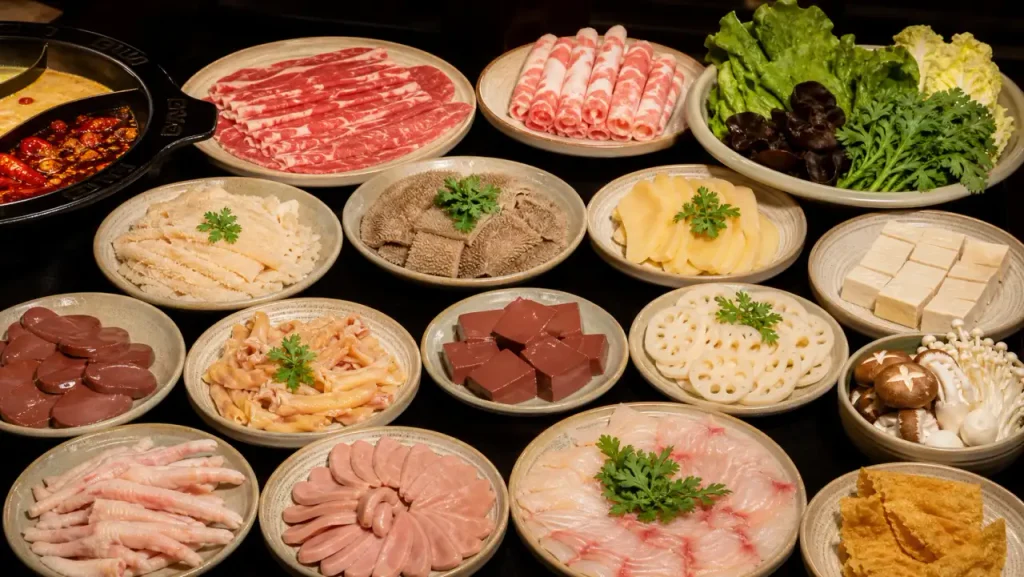
These are safe, familiar, and hard to regret.
- Thin sliced beef
- Thin sliced lamb
- Chicken slices
- Shrimp paste
- Fish balls
- Tofu
- Frozen tofu
- Napa cabbage
- Lettuce
- Potato slices
- Lotus root
- Enoki mushrooms
- Shiitake mushrooms
- Wide noodles
- Rice cakes
If this is your first hot pot meal, build your order mostly from this group. You will have a good time.
Level 2: Very Chinese, but still friendly
These feel more local but are not too scary.
- Duck blood curd
- Luncheon meat
- Beef balls
- Fish tofu
- Fried tofu skin
- Quail eggs
- Black fungus
- Konjac noodles
- Sweet potato noodles
- Celtuce
Duck blood sounds dramatic in English, but in hot pot it is soft, mild, and popular. Try a small piece if you are curious.
Level 3: Local classics for brave beginners
Now we enter the real hot pot zone.
- Beef tripe
- Duck intestine
- Yellow throat
- Pork kidney slices
- Chicken feet
- Pig brain
- Beef liver
- Pork blood
Let’s explain a few.
Beef tripe is one of the most famous hot pot ingredients, especially in Chongqing and Sichuan. It has a crunchy texture and cooks quickly.
Yellow throat is not actually throat in the way many foreigners imagine. It is usually from the aorta or similar connective tissue of cattle or pigs. The texture is crisp and bouncy.
Pork kidney slices have a stronger flavor and are usually cut thin. Locals may love them. Beginners may need emotional support.
Chicken feet are more about texture than meat. If you like gelatinous, chewy foods, you may enjoy them.
Pig brain is soft, rich, and very local. I will not pressure you. Friendship has limits.
Level 4: “I trust the local friend” ingredients
Try these only if you are comfortable with strong textures and local offal dishes:
- Duck intestine
- Goose intestine
- Pig brain
- Spicy marinated organs
- Very strong beef offal platters
These can be delicious, but they are not necessary for a successful first hot pot. You do not need to prove anything to the pot. The pot already knows who you are.
A safe first-time order
If you want a simple order for two people, try:
- Split pot: half mild, half spicy
- Thin sliced beef
- Shrimp paste
- Beef balls
- Tofu or frozen tofu
- Napa cabbage
- Lotus root
- Enoki mushrooms
- Wide noodles
- One adventurous item, such as beef tripe
This gives you comfort, texture, vegetables, protein, and just enough local flavor.
How Much Broth to Put in Hot Pot
If you are eating at a hot pot restaurant in China, you usually do not need to worry about broth amount. The restaurant handles it. If the broth gets low, staff will add more.
At home, do not fill the pot all the way to the top. Hot pot bubbles, ingredients add volume, and noodles can make everything rise. Fill the pot around half to two-thirds full, then add more broth as needed.
How much broth to put in hot pot at home
For a small home hot pot, start with about 1.5 to 2 liters of broth for two to three people. For four to six people, 3 to 4 liters is more comfortable, depending on your pot size.
The broth should be deep enough to cover ingredients, but not so full that it splashes when boiling.
Hot pot should be exciting. It should not redecorate your table.
How to make hot pot broth simple
If you are making hot pot at home, the easiest path is to buy a hot pot soup base packet from an Asian grocery store.
For a simple mild broth, you can use:
- Chicken stock
- Ginger
- Scallions
- Garlic
- Mushrooms
- A little salt
- Optional goji berries or dates
For spicy broth, unless you already understand Chinese spices, buying a soup base is easier and usually better.
There is no shame in using a packet. Many Chinese families do this too. We are not all secretly making beef tallow broth from scratch on a Tuesday.
Hot Pot Cooking Times: What to Cook First
Cooking times depend on thickness, heat level, and ingredient quality, but this table gives you a useful beginner guide.
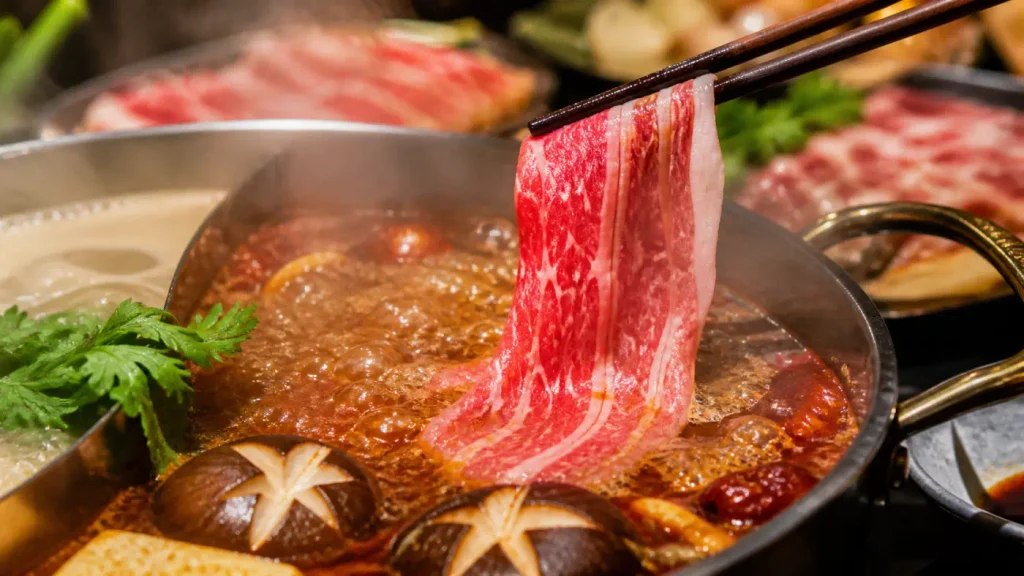
| Ingredient | Approximate cooking time | Notes |
|---|---|---|
| Thin beef or lamb slices | 10-30 seconds | Swish until color changes |
| Beef tripe | 10-20 seconds | Do not overcook or it gets tough |
| Duck intestine | 10-20 seconds | Very quick, best with local guidance |
| Leafy greens | 30-60 seconds | Cook briefly so they stay fresh |
| Tofu | 2-5 minutes | Let it absorb flavor |
| Frozen tofu | 3-6 minutes | Great in spicy broth |
| Mushrooms | 2-5 minutes | Cook fully |
| Shrimp paste | 3-5 minutes | Usually shaped into small pieces |
| Fish balls or beef balls | 5-8 minutes | Wait until fully hot inside |
| Potato slices | 3-6 minutes | Depends on thickness |
| Lotus root | 2-4 minutes | Keep it slightly crisp |
| Wide noodles | 3-8 minutes | Depends on noodle type |
| Meatballs | 5-10 minutes | Make sure they are cooked through |
| Yunnan wild mushrooms | Follow restaurant guidance | Some must cook longer |
General rule:
If it is thin, it cooks fast. If it is round, thick, frozen, or suspiciously dense, give it more time.
Hot Pot Sauce Guide
Sauce is where hot pot becomes personal.
Some restaurants have a self-service sauce bar with many options: sesame paste, garlic, cilantro, scallions, chili oil, vinegar, soy sauce, oyster sauce, fermented tofu, crushed peanuts, sesame seeds, and more.
At first, this looks fun.
Then you realize you have created a bowl of twelve ingredients that tastes like confusion.
Start simple.
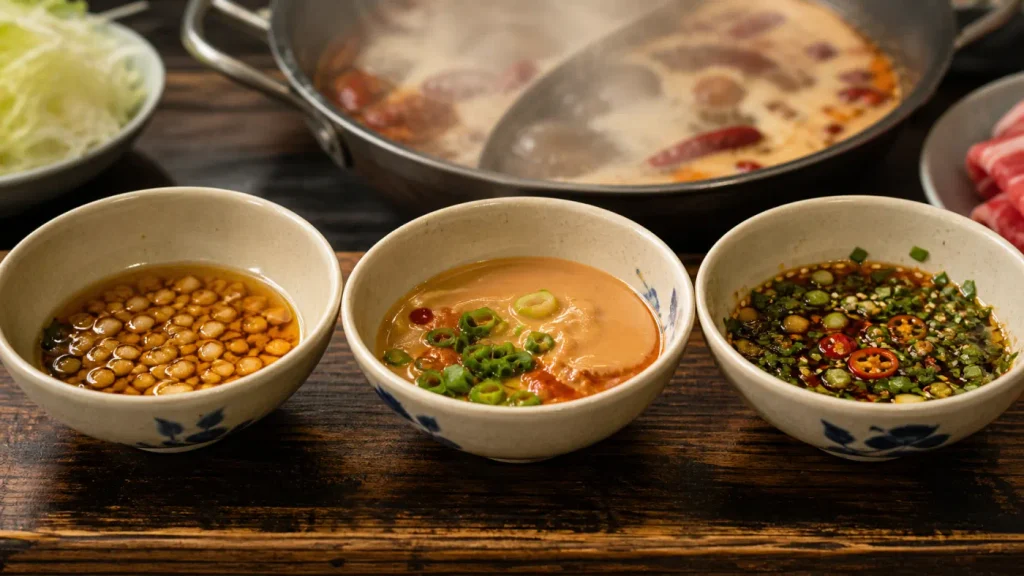
Chongqing hot pot sauce: garlic and sesame oil
For traditional Chongqing spicy hot pot, the classic dipping sauce is very simple:
- Sesame oil
- Minced garlic
Sometimes people add a little cilantro, scallion, vinegar, or oyster sauce, but the old-school version is basically garlic and oil.
Why does this match Chongqing hot pot?
Because the broth is already extremely powerful. It has chili, Sichuan peppercorn, beef tallow, spices, salt, and deep mala flavor. If you dip that into a heavy sesame paste sauce, the flavor can become too thick and muddy. Sesame oil and garlic cool the heat, coat the food, soften the spice, and let the broth remain the main character.
In Chongqing, the sauce is not trying to compete.
It is there to help you survive beautifully.
Northern lamb hot pot sauce: sesame paste
For Beijing copper-pot lamb, the classic sauce is sesame paste-based.
A common northern-style sauce may include:
- Sesame paste
- Fermented tofu
- Chinese chive flower sauce
- Soy sauce
- Chili oil
- Cilantro
- Scallion
Why does this match copper-pot lamb?
Because the broth is usually light. The lamb is thin and flavorful, but the pot itself is not as spicy or oily as Chongqing hot pot. Sesame paste adds richness, body, nuttiness, and warmth. It wraps around the lamb in a very satisfying way.
This is not a delicate sauce.
This sauce walks into the room wearing a winter coat.
Free-style sauce: for modern hot pot restaurants
If you are at a modern chain like Haidilao, you may see a large sauce bar. In that case, you can build your own sauce.
A beginner free-style sauce:
- Sesame paste or sesame oil
- Garlic
- Scallion
- Cilantro
- A little soy sauce
- A little vinegar
- Crushed peanuts or sesame seeds
- Optional chili oil
- Optional xiaomi chili
Why does this work?
Because modern hot pot restaurants often offer multiple broths and many ingredient styles. A free-style sauce lets you adjust. Eating tomato broth? Add sesame paste and garlic. Eating spicy broth? Use more sesame oil and less paste. Eating beef? Add cilantro and scallion. Eating vegetables? Vinegar can brighten the flavor.
Just remember: sauce should support the food, not bury it.
If your sauce bowl looks like a small swamp, maybe pause.
Chinese Hot Pot vs Korean Hot Pot
Because many people search “is hot pot Korean” or “what is kpot,” let’s clear this up.
Is hot pot Korean?
Hot pot-style dishes exist in Korea, but Chinese hot pot and Korean hot pot are not the same.
Chinese hot pot usually focuses on a shared broth, raw ingredients cooked at the table, dipping sauces, and regional soup bases. Korean hot pot dishes may use different broths, ingredients, seasonings, and dining formats.
Is hot pot Chinese or Korean?
The hot pot most travelers encounter in China is Chinese. But the larger idea of communal pot cooking appears in multiple food cultures.
This is like asking whether noodles are Chinese, Italian, Japanese, or Korean. The better answer is: many cultures have noodles, but each tradition has its own style.
Same with hot pot.
What is kpot?
In many English-language searches, “kpot” often refers to Korean BBQ and hot pot restaurant concepts, especially in North America. It is usually a restaurant format combining grilling and hot pot.
That can be fun, but it is not the same as eating Chongqing hot pot in Chongqing or copper-pot lamb in Beijing.
Both can be good. They are just different experiences.
Is Hot Pot Healthy?
Hot pot can be healthy. Hot pot can also become a glorious sodium-and-oil festival.
It depends on what you order, what broth you choose, and how much you eat.
When hot pot is healthy
Hot pot can be a balanced meal if you order:
- Lean meat
- Fish or seafood
- Tofu
- Mushrooms
- Leafy greens
- Root vegetables
- A lighter broth
- A sauce that is not too salty or oily
Because you choose ingredients yourself, hot pot gives you more control than many restaurant meals.
When hot pot gets heavy
Hot pot becomes heavier when you order:
- Very oily spicy broth
- Lots of fatty meat
- Many processed balls and sausages
- Too much sesame paste
- Too much salty sauce
- Sugary drinks
- Fried snacks
Also, spicy broth is usually not meant to be drunk like soup. Especially Chongqing red oil broth. Please do not treat it like tomato soup with ambition.
How to make hot pot healthier
Try this:
- Use a split pot with one mild broth.
- Order more vegetables and mushrooms.
- Choose tofu or fish.
- Use sauce lightly.
- Do not drink the spicy broth.
- Eat slowly.
- Stop before you become part of the furniture.
Hot pot is meant to be enjoyed, not optimized into sadness. You can eat well and still have fun.
How Much Is Hot Pot Per Person in China?
Hot pot prices vary by city, restaurant type, ingredients, and how hungry your friends are.
Here is a realistic rough guide.
| Type of hot pot restaurant | Typical cost per person | What to expect |
|---|---|---|
| Budget local hot pot | 50-90 RMB($10–15) | Simple setting, local crowd, good value |
| Mid-range chain | 90-150 RMB($15–25) | Cleaner environment, easier ordering, stable quality |
| Popular spicy hot pot brand | 120-180 RMB($25–40) | Stronger atmosphere, better ingredients, often busy |
| Premium hot pot | 180-300+ RMB($40–50+) | Better beef, seafood, service, private rooms |
| Luxury or specialty beef hot pot | 300+ RMB($50+) | High-end cuts, refined service, premium setting |
In Chengdu and Chongqing, you can still find very good local hot pot that is not too expensive. In Shanghai, Beijing, Shenzhen, or tourist-heavy areas, prices can climb quickly.
Popular hot pot restaurants and chains in China
This is not a strict ranking, because the “best” hot pot depends on city, style, budget, and your spice tolerance. But these are well-known names travelers may see.
| Restaurant or style | Best for | Notes |
|---|---|---|
| Haidilao | First-timers, service, easy ordering | Famous chain with strong service and sauce bar |
| Xiaolongkan | Sichuan-style atmosphere | Popular spicy hot pot brand |
| Dalongyi | Spicy Sichuan-style hot pot | Better for people who like heat |
| Banu Hot Pot | Quality ingredients, especially tripe | Known for ingredient focus |
| Xiabu Xiabu | Casual individual hot pot | Easy and often more affordable |
| Local Chongqing old hot pot shops | Strong local flavor | Best with a local friend or brave stomach |
| Chaoshan beef hot pot restaurants | Fresh beef, non-spicy option | Great for beginners who do not want mala |
| Beijing copper-pot lamb restaurants | Northern lamb hot pot | Best in colder weather |
For a first-time visitor in China, Haidilao is easy because ordering is more beginner-friendly and staff are used to helping. But if you want the real local experience, especially in Chengdu or Chongqing, try a busy local shop too.
My personal rule:
If it smells amazing, has local people waiting, and the chairs are slightly too small, there is a good chance the food is serious.
Hot Pot Etiquette in China
Hot pot is casual, but there are still a few rules.
Use serving chopsticks when possible
If there are serving chopsticks or tongs, use them for raw meat. Do not use the same chopsticks for raw meat and eating unless the restaurant setup makes that unavoidable.
Food safety is attractive. Quietly attractive, but attractive.
Do not put everything in at once
This is not only about cooking. It is also table manners. If you dump everything in, other people cannot control what they want to eat.
Add a little, cook, share, repeat.
Do not steal the last good piece too aggressively
Hot pot is communal. If one beautiful piece of beef is floating there, look around first. If everyone looks away, destiny has spoken.
Do not change the spice level without asking
If you share a pot, ask before adding chili, broth, or strong seasonings.
Help fish out food
If someone loses tofu, help them. This is how friendship is built.
First-Time Hot Pot Mistakes to Avoid
Mistake 1: Ordering a broth that is too spicy
In Sichuan and Chongqing, spicy means spicy. If you are not sure, order mild spicy or a split pot.
Say:
微辣。
Wēi là.
Mild spicy.
Or:
不要太辣。
Bùyào tài là.
Not too spicy.
Mistake 2: Putting everything in at once
You will lose things. You will overcook things. The pot will become chaos.
Cook in small batches.
Mistake 3: Eating meat too early
Thin beef cooks quickly, but not everything does. Meatballs, chicken, pork, and seafood need enough time.
When in doubt, wait a little longer.
Mistake 4: Drinking the spicy broth
Clear broth? Maybe.
Tomato broth? Sure.
Chongqing red oil broth? Please do not.
Mistake 5: Making a sauce with everything
The sauce bar is exciting. But more ingredients do not always mean better sauce.
Start with one classic formula. Then adjust.
Mistake 6: Forgetting to pace yourself
Hot pot starts slowly. Then suddenly you realize you have eaten beef, tofu, noodles, mushrooms, duck blood, three sauces, and half your personality.
Take breaks.
How to Order Hot Pot in China
If you are in China and the menu is only in Chinese, do not panic. Many restaurants now use QR code menus with pictures. Translation apps help too.
Here are useful phrases.
Useful Chinese phrases
鸳鸯锅
Yuānyāng guō
Split pot
清汤
Qīng tāng
Clear broth
番茄锅
Fānqié guō
Tomato broth
菌汤锅
Jūn tāng guō
Mushroom broth
麻辣锅
Málà guō
Spicy numbing broth
微辣
Wēi là
Mild spicy
不吃辣
Bù chī là
I do not eat spicy food
推荐一下
Tuījiàn yíxià
Please recommend something
这个煮多久?
Zhège zhǔ duōjiǔ?
How long should this cook?
加汤
Jiā tāng
Add more broth
What to order if you are nervous
Use this simple order:
- Split pot
- Tomato or mushroom broth
- Mild spicy broth
- Thin sliced beef
- Shrimp paste
- Beef balls
- Tofu
- Napa cabbage
- Mushrooms
- Lotus root
- Wide noodles
Optional brave item:
- Beef tripe
That is enough for a good first meal.
How to Make Hot Pot at Home
If you want to make hot pot at home, keep it simple.
You need:
- A portable burner or electric hot pot
- A wide pot
- Broth or hot pot soup base
- Thin sliced meat
- Vegetables
- Mushrooms
- Tofu
- Noodles
- Dipping sauce ingredients
- Chopsticks and small bowls
The easiest version:
- Buy a hot pot soup base.
- Prepare ingredients on plates.
- Bring broth to a simmer.
- Cook ingredients in small batches.
- Dip and eat.
Do not overcomplicate it. Hot pot is not about perfect cooking technique. It is about the table.
If your friends are happy and the pot is bubbling, you are doing it right.
FAQ About Hot Pot
How to eat hot pot?
Choose a broth, order raw ingredients, cook them in the pot, dip them in sauce, and eat slowly with others. Cook small batches instead of adding everything at once.
How does hot pot work?
A pot of broth stays hot at the table. Diners add raw ingredients into the broth, wait until they are cooked, then remove them and eat with dipping sauce.
What is in a hot pot?
Common hot pot ingredients include sliced beef, lamb, seafood, tofu, mushrooms, leafy greens, noodles, meatballs, tripe, duck blood, and regional specialties.
What to put in hot pot?
For beginners, try sliced beef, shrimp paste, tofu, mushrooms, napa cabbage, lotus root, beef balls, and wide noodles. Add one adventurous item like beef tripe if you want.
How to cook hot pot?
Keep the broth simmering, add ingredients in small batches, cook thin meats briefly, cook thicker items longer, and use serving chopsticks or tongs for raw food.
How much broth to put in hot pot?
At home, fill the pot about half to two-thirds full. In restaurants, staff usually manage the broth and add more when needed.
Is hot pot healthy?
Hot pot can be healthy if you choose vegetables, tofu, lean meat, mushrooms, and lighter broth. It becomes heavier with oily broth, fatty meat, processed items, and salty sauces.
How much is hot pot per person?
In China, hot pot often costs about 50-90 RMB per person at budget local places, 90-150 RMB at mid-range chains, and 180 RMB or more at premium restaurants.
Is hot pot Chinese or Korean?
The hot pot most travelers encounter in China is Chinese hot pot. Korea also has hot pot-style dishes, but Chinese and Korean versions have different broths, ingredients, and dining styles.
What is kpot?
In English-language searches, kpot often refers to Korean BBQ and hot pot restaurant concepts, especially outside Asia. It is different from traditional Chinese hot pot.
Where did hot pot come from?
Shared-pot cooking has many regional histories, but spicy Chongqing hot pot is often linked to river port culture, where boatmen and dock workers cooked inexpensive ingredients in bold, warming broth.
Final Thoughts: Hot Pot Is Easier Than It Looks
Hot pot looks complicated because there are many choices.
But the basic flow is simple:
Pick broth. Make sauce. Cook food. Dip. Eat. Repeat.
If you are in China for the first time, hot pot is one of the best meals to try because it teaches you so much at once: local flavor, group dining, spice culture, regional identity, and the Chinese talent for turning dinner into an event.
Start with a split pot. Order a few safe ingredients. Try one brave thing. Make a simple sauce. Ask the server when you are unsure.
And if a local friend tells you, “This is not spicy,” be careful.
They may be a wonderful person.
But they may also be from Sichuan.